An S-corporation Can Have No More Than Twenty Stockholders.
6 Chapter six Forms of Business Ownership
Stephen Skripak; Anastasia Cortes; and Anita Walz
Learning Objectives
- Identify the questions to ask in choosing the appropriate form of buying for a business.
- Depict the sole proprietorship and partnership forms of system, and specify the advantages and disadvantages.
- Place the unlike types of partnerships, and explain the importance of a partnership understanding.
- Explain how corporations are formed and how they operate.
- Discuss the advantages and disadvantages of the corporate class of ownership.
- Examine special types of business ownership, including express-liability companies, and not-for-turn a profit corporations.
- Ascertain mergers and acquisitions, and explain why companies are motivated to merge or acquire other companies.
The Ice Foam Men
Who would have thought it? Two ex-hippies with stiff interests in social activism would stop up starting one of the best-known ice cream companies in the land—Ben & Jerry's. Perhaps information technology was meant to be. Ben Cohen (the "Ben" of Ben & Jerry's) always had a fascination with water ice foam. Equally a kid, he made his own mixtures by dandy his favorite cookies and candies into his ice cream. But it wasn't until his senior year in high school that he became an official "ice foam human," happily driving his truck through neighborhoods filled with kids eager to buy his ice cream pops. Subsequently high school, Ben tried college but it wasn't for him. He attended Colgate University for a year and a half before he dropped out to return to his existent love: being an water ice cream man. He tried college once again—this fourth dimension at Skidmore, where he studied pottery and jewelry making—but, in spite of his selection of courses, still didn't like information technology.

In the meantime, Jerry Greenfield (the "Jerry" of Ben & Jerry's) was following a similar path. He majored in pre-med at Oberlin College in the hopes of one day condign a doctor. But he had to surrender on this goal when he was not accepted into medical school. On a positive note, though, his college didactics steered him into a more lucrative field: the world of water ice cream making. He got his first peek at the water ice foam manufacture when he worked every bit a scooper in the student cafeteria at Oberlin. And so, fourteen years afterwards they starting time met on the junior loftier school rails team, Ben and Jerry reunited and decided to go into water ice foam making large fourth dimension. They moved to Burlington, Vermont—a college boondocks in need of an ice cream parlor—and completed a $5 correspondence course from Penn State on making ice cream. After getting an A in the course—not surprising, given that the tests were open book—they took the plunge: with their life savings of $eight,000 and $4,000 of borrowed funds they gear up an water ice cream store in a made-over gas station on a busy street corner in Burlington.1 The side by side big determination was which class of business buying was best for them. This affiliate introduces you lot to their options.
Factors to Consider
If you're starting a new business organisation, yous have to decide which legal class of ownership is best for you and your business. Practice you want to own the concern yourself and operate as a sole proprietorship? Or, do you desire to share buying, operating equally a partnership or a corporation? Earlier we discuss the pros and cons of these 3 types of buying, let'south address some of the questions that you'd probably ask yourself in choosing the appropriate legal form for your business.
- In setting up your business organisation, practice you want to minimize the costs of getting started? Do y'all hope to avoid circuitous government regulations and reporting requirements?
- How much command would you lot like? How much responsibleness for running the business are you willing to share? What about sharing the profits?
- Do you lot want to avoid special taxes?
- Do y'all take all the skills needed to run the business?
- Are you likely to get along with your co-owners over an extended period of time?
- Is it important to you lot that the business survive y'all?
- What are your financing needs and how do you program to finance your company?
- How much personal exposure to liability are you willing to accept? Do you feel uneasy nigh accepting personal liability for the deportment of young man owners?
No single form of ownership volition requite you everything you desire. You'll accept to brand some trade-offs. Because each selection has both advantages and disadvantages, your job is to decide which one offers the features that are most important to you. In the following sections we'll compare three ownership options (sole proprietorship, partnership, corporation) on these eight dimensions.
Sole Proprietorship and its Advantages
In a sole proprietorship, as the owner, you lot have complete control over your business concern. Y'all make all important decisions and are generally responsible for all day-to-twenty-four hours activities. In exchange for assuming all this responsibleness, you get all the income earned by the business. Profits earned are taxed equally personal income, so y'all don't have to pay whatsoever special federal and state income taxes.
Disadvantages of Sole Proprietorships
For many people, even so, the sole proprietorship is not suitable. The flip side of enjoying complete control is having to supply all the different talents that may be necessary to make the business organization a success. And when you're gone, the business concern dissolves. Yous also have to rely on your ain resources for financing: in effect, you are the business and whatsoever money borrowed past the business is loaned to you lot personally. Even more than important, the sole proprietor bears unlimited liability for any losses incurred past the business. The principle of unlimited personal liability means that if the business incurs a debt or suffers a ending (say, getting sued for causing an injury to someone), the owner is personally liable. As a sole proprietor, you lot put your personal avails (your bank account, your motorcar, maybe fifty-fifty your home) at risk for the sake of your business. You lot tin can lessen your risk with insurance, yet your liability exposure can still be substantial. Given that Ben and Jerry decided to kickoff their ice cream business together (and therefore the business was non owned by only i person), they could non set their company up every bit a sole proprietorship.
Partnership
A partnership (or full general partnership) is a business owned jointly by two or more than people. Well-nigh 10 pct of U.S. businesses are partnershipstwo and though the vast majority are modest, some are quite large. For instance, the big four public bookkeeping firms are partnerships. Setting up a partnership is more complex than setting up a sole proprietorship, simply it's yet relatively easy and inexpensive. The cost varies according to size and complexity. It'due south possible to form a simple partnership without the help of a lawyer or an accountant, though it's normally a proficient thought to get professional advice.
Professionals can aid you lot place and resolve bug that may later create disputes amid partners.
The Partnership Agreement
The impact of disputes can be lessened if the partners accept executed a well-planned partnership understanding that specifies everyone's rights and responsibilities. The agreement might provide such details every bit the following:
- Corporeality of cash and other contributions to be fabricated by each partner
- Division of partnership income (or loss)
- Partner responsibilities—who does what
- Atmospheric condition under which a partner tin sell an interest in the company
- Weather condition for dissolving the partnership
- Conditions for settling disputes
Unlimited Liability and the Partnership
A major trouble with partnerships, as with sole proprietorships, is unlimited liability: in this case, each partner is personally liable not only for his or her ain actions simply too for the deportment of all the partners. If your partner in an architectural house makes a mistake that causes a structure to collapse, the loss your business organization incurs impacts you but as much every bit information technology would him or her. And here's the actually bad news: if the business doesn't have the cash or other avails to cover losses, yous can be personally sued for the amount owed. In other words, the political party who suffered a loss because of the error can sue yous for your personal assets. Many people are understandably reluctant to enter into partnerships because of unlimited liability. Certain forms of businesses allow owners to limit their liability. These include limited partnerships and corporations.
Limited Partnerships
The law permits business owners to form a limited partnership which has two types of partners: a single general partner who runs the business and is responsible for its liabilities, and any number of limited partners who have limited interest in the business and whose losses are limited to the amount of their investment.
Advantages and Disadvantages of Partnerships
The partnership has several advantages over the sole proprietorship. Get-go, it brings together a diverse group of talented individuals who share responsibility for running the business. Second, information technology makes financing easier: the business can describe on the financial resources of a number of individuals. The partners non only contribute funds to the business but tin can also use personal resources to secure banking concern loans. Finally, continuity needn't be an issue because partners can agree legally to allow the partnership to survive if 1 or more partners dice.
Still, at that place are some negatives. Start, as discussed earlier, partners are discipline to unlimited liability. Second, being a partner means that yous accept to share determination making, and many people aren't comfortable with that situation. Not surprisingly, partners often take differences of opinion on how to run a concern, and disagreements can escalate to the bespeak of jeopardizing the continuance of the business organisation. Third, in addition to sharing ideas, partners also share profits. This organisation can work equally long as all partners feel that they're beingness rewarded co-ordinate to their efforts and accomplishments, but that isn't always the example. While the partnership form of ownership is viewed negatively by some, it was particularly appealing to Ben Cohen and Jerry Greenfield. Starting their ice cream business as a partnership was inexpensive and permit them combine their express financial resources and use their diverse skills and talents. As friends they trusted each other and welcomed shared decision making and profit sharing. They were also not reluctant to be held personally liable for each other's actions.
Corporation
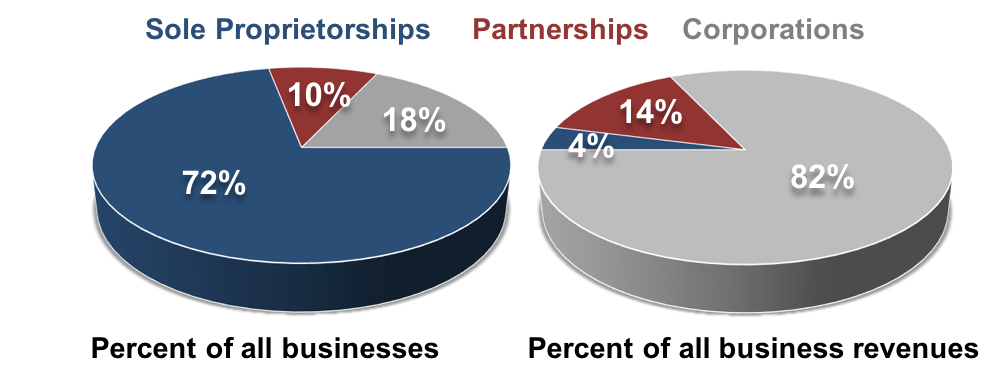
A corporation (sometimes called a regular or C-corporation) differs from a sole proprietorship and a partnership because it's a legal entity that is entirely separate from the parties who ain information technology. It can enter into binding contracts, buy and sell property, sue and be sued, be held responsible for its deportment, and be taxed. Once businesses reach any substantial size, it is advantageous to organize as a corporation so that its owners can limit their liability. Corporations, then, tend to exist far larger, on average, than businesses using other forms of ownership. Every bit Figure 6.2 shows, corporations account for eighteen pct of all U.South. businesses but generate virtually 82 percent of the revenues.3 Most large well-known businesses are corporations, simply so are many of the smaller firms with which likely you practise business.
Ownership and Stock
Corporations are owned past shareholders who invest money in the business past buying shares of stock. The portion of the corporation they own depends on the percentage of stock they hold. For instance, if a corporation has issued 100 shares of stock, and yous own thirty shares, y'all ain 30 percent of the company. The shareholders elect a board of directors, a group of people (primarily from outside the corporation) who are legally responsible for governing the corporation. The board oversees the major policies and decisions made by the corporation, sets goals and holds management accountable for achieving them, and hires and evaluates the peak executive, generally called the CEO (chief executive officer). The board too approves the distribution of income to shareholders in the form of greenbacks payments chosen dividends.
Benefits of Incorporation
The corporate class of organization offers several advantages, including limited liability for shareholders, greater access to financial resources, specialized direction, and continuity.
Limited Liability
The about important do good of incorporation is the limited liability to which shareholders are exposed: they are not responsible for the obligations of the corporation, and they can lose no more than the corporeality that they have personally invested in the company. Limited liability would accept been a big plus for the unfortunate private whose business partner burned downward their dry out cleaning institution. Had they been incorporated, the corporation would have been liable for the debts incurred by the burn. If the corporation didn't have plenty money to pay the debt, the individual shareholders would not take been obligated to pay anything. They would take lost all the coin that they'd invested in the business, simply no more.
Financial Resources
Incorporation also makes it possible for businesses to enhance funds by selling stock. This is a large advantage as a company grows and needs more funds to operate and compete. Depending on its size and financial strength, the corporation also has an advantage over other forms of business organisation in getting bank loans. An established corporation can borrow its own funds, but when a modest business organisation needs a loan, the depository financial institution commonly requires that information technology be guaranteed past its owners.
Specialized Management
Because of their size and ability to pay high sales commissions and benefits, corporations are generally able to concenter more skilled and talented employees than are proprietorships and partnerships.
Continuity and Transferability
Another advantage of incorporation is continuity. Because the corporation has a legal life split up from the lives of its owners, it can (at least in theory) exist forever.
Transferring ownership of a corporation is like shooting fish in a barrel: shareholders simply sell their stock to others. Some founders, yet, desire to restrict the transferability of their stock and and so choose to operate as a privately-held corporation. The stock in these corporations is held by but a few individuals, who are not allowed to sell information technology to the general public.
Companies with no such restrictions on stock sales are chosen public corporations; stock is available for auction to the general public.
Drawbacks to Incorporation
Similar sole proprietorships and partnerships, corporations take both positive and negative aspects. In sole proprietorships and partnerships, for instance, the individuals who own and manage a business are the same people. Corporate managers, however, don't necessarily own stock, and shareholders don't necessarily work for the visitor. This situation can be troublesome if the goals of the two groups differ significantly.
Managers, for example, are often more interested in career advancement than the overall profitability of the company. Stockholders might care more most profits without regard for the well-beingness of employees. This situation is known as the bureau problem, a conflict of involvement inherent in a relationship in which one party is supposed to human activity in the best interest of the other. It is often quite difficult to prevent self-interest from entering into these situations.
Another drawback to incorporation—one that often discourages small businesses from incorporating—is the fact that corporations are more costly to set up. When you combine filing and licensing fees with accounting and attorney fees, incorporating a business could set you dorsum past $1,000 to $6,000 or more depending on the size and scope of your business.4 Additionally, corporations are bailiwick to levels of regulation and governmental oversight that tin can place a burden on pocket-sized businesses. Finally, corporations are subject to what'south generally called "double revenue enhancement." Corporations are taxed by the federal and land governments on their earnings. When these earnings are distributed as dividends, the shareholders pay taxes on these dividends. Corporate profits are thus taxed twice—the corporation pays the taxes the first time and the shareholders pay the taxes the second fourth dimension.
5 years later on starting their water ice cream business concern, Ben Cohen and Jerry Greenfield evaluated the pros and cons of the corporate form of buying, and the "pros" won. The master motivator was the need to raise funds to build a $two million manufacturing facility. Not only did Ben and Jerry determine to switch from a partnership to a corporation, but they also decided to sell shares of stock to the public (and thus become a public corporation). Their sale of stock to the public was a scrap unusual: Ben and Jerry wanted the community to own the company, so instead of offering the stock to anyone interested in buying a share, they offered stock to residents of Vermont but. Ben believed that "business has a responsibility to give back to the community from which information technology draws its support."5 He wanted the company to be owned by those who lined up in the gas station to buy cones. The stock was so popular that i in every hundred Vermont families bought stock in the company.6 Eventually, as the company continued to expand, the stock was sold on a national level.
The original version of this chapter contained H5P content. This content is not supported in cloned books. Y'all may want to remove or supervene upon this department.
Other Types of Business Ownership
In add-on to the three commonly adopted forms of business organisation organization—sole proprietorship, partnership, and regular corporations—some business owners select other forms of organization to meet their particular needs. We'll look at two of these options:
- Express-liability companies
- Not-for-turn a profit corporations
Express-Liability Companies
How would y'all like a legal form of organisation that provides the attractive features of the three common forms of organization (corporation, sole proprietorship and partnership) and avoids the unattractive features of these three organization forms? The express-liability company (LLC) accomplishes exactly that. This form provides business owners with limited liability (a central reward of corporations) and no "double taxation" (a fundamental advantage of sole proprietorships and partnerships). Permit's look at the LLC in more detail.
In 1977, Wyoming became the first country to allow businesses to operate as limited-liability companies. Xx years later, in 1997, Hawaii became the final country to give its blessing to the new organization class. Since and then, the limited-liability company has increased in popularity. Its rapid growth was fueled in function by changes in state statutes that permit a limited-liability company to have just one member. The trend to LLCs tin can be witnessed past reading company names on the side of trucks or on storefronts in your urban center. It is common to see names such every bit Jim Evans Tree Care, LLC, and For-Cats-Only Veterinary Clinic, LLC. Merely LLCs are not limited to modest businesses. Companies such equally Crayola, Domino's Pizza, Ritz-Carlton Hotel Company, and iSold Information technology (which helps people sell their unwanted belongings on eBay) are operating under the limited-liability grade of organization.
In a limited-liability company, owners (called members rather than shareholders) are not personally liable for debts of the company, and its earnings are taxed just once, at the personal level (thereby eliminating double taxation).
We accept touted the benefits of express liability protection for an LLC. We now need to bespeak out some circumstances under which an LLC member (or a shareholder in a corporation) might be held personally liable for the debts of his or her company. A business possessor can exist held personally liable if he or she:
- Personally guarantees a business debt or banking company loan which the company fails to pay.
- Fails to pay employment taxes to the government.
- Engages in fraudulent or illegal behavior that harms the company or someone else.
- Does not treat the company as a separate legal entity, for example, uses company avails for personal uses.
Not-for-Profit Corporations
A non-for-profit corporation (sometimes called a nonprofit) is an system formed to serve some public purpose rather than for financial proceeds. Equally long as the organization's activity is for charitable, religious, educational, scientific, or literary purposes, it can exist exempt from paying income taxes. Additionally, individuals and other organizations that contribute to the not-for-profit corporation can take a tax deduction for those contributions. The types of groups that ordinarily use for nonprofit status vary widely and include churches, synagogues, mosques, and other places of worship; museums; universities; and conservation groups.
There are more than 1.v million not-for-profit organizations in the Usa.7 Some are extremely well funded, such as the Pecker and Melinda Gates Foundation, which has an endowment of approximately $forty billion and has given away $36.7 billion since its inception.8 Others are nationally recognized, such as United Way, Goodwill Industries, Habitat for Humanity, and the Red Cantankerous. However the vast bulk is neither rich nor famous, just nevertheless makes significant contributions to social club.
The original version of this chapter contained H5P content. This content is not supported in cloned books. Yous may want to remove or replace this section.
Mergers and Acquisitions
The headline read, "Wanted: More than 2,000 in Google Hiring Spree."9 The largest Spider web search engine in the world was disclosing its plans to grow internally and increase its workforce by more than than two,000 people, with half of the hires coming from the United States and the other half coming from other countries. The added employees will assistance the company aggrandize into new markets and battle for global talent in the competitive Internet information providers manufacture. When properly executed, internal growth benefits the firm.
An alternative approach to growth is to merge with or acquire another company. The rationale behind growth through merger or conquering is that 1 + 1 = 3: the combined visitor is more valuable than the sum of the 2 dissever companies. This rationale is bonny to companies facing competitive pressures. To grab a bigger share of the market and improve profitability, companies volition want to become more cost efficient by combining with other companies.
Mergers and Acquisitions
Though they are often used as if they're synonymous, the terms merger and acquisition mean slightly different things. A merger occurs when two companies combine to form a new visitor. An conquering is the purchase of 1 company by another. An example of a merger is the merging in 2022 of US Airways and American Airlines. The combined company, the largest carrier in the world, flies nether the proper noun American Airlines.
Some other case of an acquisition is the purchase of Reebok by Adidas for $3.8 billion.x The bargain was expected to give Adidas a stronger presence in Northward America and help the company compete with rival Nike. Once this conquering was completed, Reebok as a company ceased to be, though Adidas still sells shoes under the Reebok make.
Motives behind Mergers and Acquisitions
Companies are motivated to merge or acquire other companies for a number of reasons, including the post-obit.
Proceeds Complementary Products
Acquiring complementary products was the motivation behind Adidas's conquering of Reebok. Equally Adidas CEO Herbert Hainer stated in a conference call, "This is a one time-in- a-lifetime opportunity. This is a perfect fit for both companies, considering the companies are so complementary…. Adidas is grounded in sports performance with such products equally a motorized running shoe and endorsement deals with such superstars as British soccer player David Beckham. Meanwhile, Reebok plays heavily to the melding of sports and amusement with endorsement deals and products by Nelly, Jay-Z, and 50 Cent. The combination could be deadly to Nike." Of class, Nike has continued to thrive, but 1 can't blame Hainer for his optimism.11
Attain New Markets or Distribution Channels
Gaining new markets was a significant cistron in the 2005 merger of US Airways and America West. Usa Airways was a major actor on the East Declension, the Caribbean, and Europe, while America W was strong in the Due west. The expectations were that combining the two carriers would create an airline that could accomplish more markets than either carrier could do on its ain.12
Realize Synergies
The purchase of Pharmacia Corporation (a Swedish pharmaceutical visitor) by Pfizer (a enquiry-based pharmaceutical company based in the Us) in 2003 created i of the world's largest drug makers and pharmaceutical companies, by revenue, in every major market place around the globe.13 The acquisition created an industry behemothic with more than $48 billion in acquirement and a research-and-development budget of more than $7 billion. Each solar day, almost forty million people around the globe are treated with Pfizer medicines.fourteen Its subsequent $68 billion buy of rival drug maker Wyeth further increased its presence in the pharmaceutical marketplace.15
In pursuing these acquisitions, Pfizer probable identified many synergies: quite simply, a whole that is greater than the sum of its parts. There are many examples of synergies. A merger typically results in a number of redundant positions; the combined company does not probable need two vice-presidents of marketing, two principal financial officers, and then on. Eliminating the redundant positions leads to significant cost savings that would not be realized if the two companies did not merge. Let's say each of the companies was operating factories at 50% of capacity, and past merging, one factory could be closed and sold. That would also exist an example of a synergy. Companies bring different strengths and weaknesses into the merged entity. If the newly-combined company tin take advantage of the marketing capabilities of the stronger entity and the distribution capabilities of the other (bold they are stronger), the new company can realize synergies in both of these functions.
Hostile Takeover
What happens, though, if one company wants to acquire another visitor, just that company doesn't want to exist acquired? The consequence could be a hostile takeover—an act of assuming control that'southward resisted by the targeted company'southward management and its board of directors. Ben Cohen and Jerry Greenfield institute themselves in one of these situations: Unilever—a very large Dutch/British visitor that owns three ice foam brands—wanted to purchase Ben & Jerry's, against the founders' wishes. Nearly of the Ben & Jerry's stockholders sided with Unilever. They had lilliputian confidence in the ability of Ben Cohen and Jerry Greenfield to continue managing the company and were frustrated with the firm'south social-mission focus. The stockholders liked Unilever'southward offer to buy their Ben & Jerry's stock at well-nigh twice its current market place cost and wanted to have their profits. In the cease, Unilever won; Ben & Jerry's was acquired by Unilever in a hostile takeover.16 Despite fears that the company'south social mission would end, information technology didn't happen. Though neither Ben Cohen nor Jerry Greenfield are involved in the electric current management of the company, they have returned to their social activism roots and are heavily involved in numerous social initiatives sponsored by the visitor.
The original version of this affiliate independent H5P content. This content is non supported in cloned books. You may desire to remove or replace this section.
Chapter Video: Business organization Structures
Here is a short video providing a simple and straightforward recap of the key points of each form of business concern ownership.
(Copyrighted textile)
Key Takeaways
- A sole proprietorship, a business concern owned past only one person, accounts for 72% of all U.Southward. businesses.
- Advantages include: complete command for the owner, like shooting fish in a barrel and inexpensive to form, and owner gets to keep all of the profits.
- Disadvantages include: unlimited liability for the owner, complete responsibleness for talent and financing, and business organisation dissolves if the owner dies.
- A general partnership is a business organisation endemic jointly by 2 or more people, and accounts for about ten% of all U.Due south. businesses.
- Advantages include: more than resources and talents come up with an increment in partners, and the business tin can continue even after the expiry of a partner.
- Disadvantages include: partnership disputes, unlimited liability, and shared profits.
- A limited partnership has a single full general partner who runs the business concern and is responsible for its liabilities, plus any number of limited partners who have limited interest in the business and whose losses are express to the amount of their investment.
- A corporation is a legal entity that's separate from the parties who own it, the shareholders who invest past buying shares of stock. Corporations are governed by a Lath of Directors, elected by the shareholders.
- Advantages include: limited liability, easier access to financing, and unlimited life for the corporation.
- Disadvantages include: the agency problem, double tax, and incorporation expenses and regulations.
- A limited-liability company (LLC) is a business construction that combines the tax treatment of a partnership with the liability protection of a corporation.
- A non-for-turn a profit corporation is an organization formed to serve some public purpose rather than for financial gain. Information technology enjoys favorable taxation handling.
- A merger occurs when two companies combine to form a new company.
- An acquisition is the purchase of ane company by another with no new visitor being formed. A hostile takeover occurs when a company is purchased fifty-fifty though the company's management and Board of Directors do not want to be acquired.
Chapter 6 Text References and Paradigm Credits
Epitome Credits: Chapter six
Effigy 6.1: Dismas (2010). " Ben Cohen and Jerry Greenfield in 2010 ." CC past SA 3.0 Retrieved from: https://en.wikipedia.org/wiki/Ben_%26_Jerry%27s – /media/File:Ben_and_Jerry.jpg .
Figure half-dozen.2: "Types of U.S. Businesses." Data source: "Number of Tax Returns, Receipts, and Net Income by Type of Business organisation." Census.gov. Retrieved from: https://www.demography.gov/prod/2011pubs/12statab/business.pdf
Video Credits: Chapter 6
"Business Structures." (Edible bean Counter). March 9, 2014. Retrieved from: https://world wide web.youtube.com/lookout man?v=z-GLrHhuDEM
References: Chapter 6
ane Fred Chico Lager (1994). Ben & Jerry's: The Inside Scoop. New York: Crown Publishers.
five Fred Chico Lager (1994). Ben & Jerry's: The Inside Scoop. New York: Crown Publishers. P. 91.
6 Fred Chico Lager (1994). Ben & Jerry's: The Inside Scoop. New York: Crown Publishers. P. 103.
7 Urban Institute National Middle for Charitable Statistics (2010). "Number of Nonprofit Organizations in the United States, 1999 – 2009." Urban Institute National Middle for Charitable Statistics Retrieved from: http://nccsdataweb.urban.org/PubApps/profile1.php?state=United states
Source: https://viva.pressbooks.pub/fundamentalsofbusiness/chapter/chapter-6-forms-of-business-ownership/
0 Response to "An S-corporation Can Have No More Than Twenty Stockholders."
Post a Comment